
Formula 1 teams will operate under the sport’s largest technical overhaul in more than a decade when the 2026 regulations arrive. FIA documentation confirms sweeping revisions to chassis dimensions, aerodynamic behavior, sustainable fuel integration, and a new power-unit formula that dramatically increases electrical output. Historical race simulations, tire-degradation models, and qualifying projections built on the current era suddenly become far less reliable.
Research from Formula 1, Motorsport.com, and several early engineering assessments tied to 2026 F1 betting strategy discussions shows one consistent theme: volatility will dominate the opening phase of the season. That matters because most motorsport betting systems rely heavily on historical continuity. Past lap-time trends, track-specific performance ratings, and long-run pace correlations lose predictive power when regulations reshape the cars themselves.
Professional bettors usually want stability. Rule resets create the opposite. Sharp market edges often appear during the first six to ten races because sportsbooks are recalibrating at the same time as the teams. Understanding how to rebuild your evaluation process becomes more important than memorizing previous-season statistics.
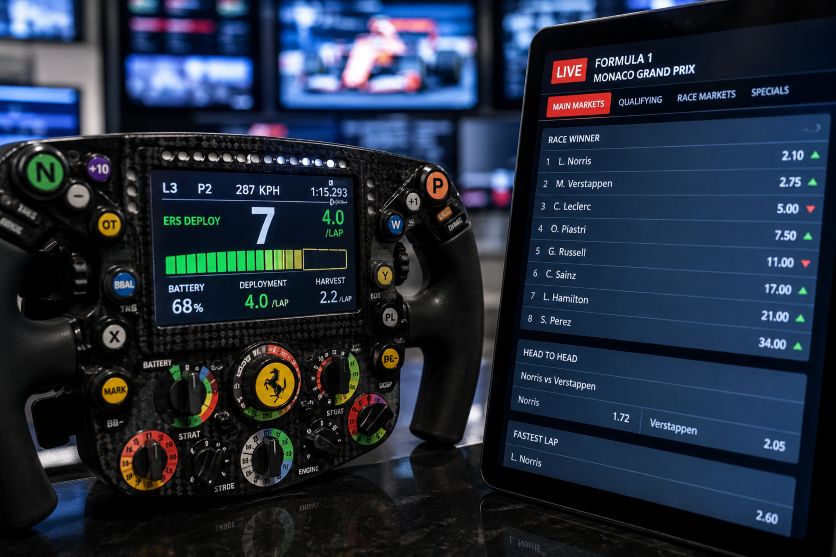
Why Historical Data Suddenly Became Dangerous
Most F1 betting models depend on three core assumptions. First, team performance evolves gradually. Second, track-specific strengths carry over year to year. Third, aerodynamic and power-unit development trends remain comparable over multiple seasons. The 2026 reset weakens all three assumptions at once.
The FIA states that the new cars will feature active aerodynamics, reduced overall dimensions, narrower bodywork, lower drag targets, and a revised energy deployment system. Data from the current ground-effect era becomes less transferable because the mechanical and aerodynamic balance of the cars changes significantly.
Mercedes-AMG Petronas engineers have publicly noted that active aero systems will likely create wider setup variation between circuits. Research published by The Race also suggests the increased electrical dependency may amplify performance swings tied to battery deployment efficiency.
That means a team dominant at high-speed circuits in 2025 may not maintain the same advantage under the new framework. Old assumptions become traps for bettors who overvalue historical consistency.
The Five Biggest Changes Bettors Must Reprice
1. Smaller Chassis and Revised Handling Characteristics
The FIA confirmed the 2026 cars will be shorter, narrower, and lighter than current machines. Smaller chassis generally improve agility through slower corners and tight sectors. That affects circuit profiling.
Tracks previously considered poor fits for heavier cars may suddenly reward different design concepts. Monaco, Singapore, Hungary, and Mexico City could produce entirely different competitive orders compared with the previous generation.
Bettors should reduce the weight assigned to historical track-performance databases during the opening portion of the season. A three-year rolling average may become almost useless until new evidence forms.
2. The 50/50 Power Split Changes Race Dynamics
The FIA technical regulations outline a near 50/50 split between internal combustion power and electrical energy contribution. Current cars rely far more heavily on combustion output. This matters because energy deployment efficiency becomes a much larger performance differentiator.
Teams with superior battery recovery systems may gain enormous advantages at tracks with repeated braking zones. Others may struggle late in laps if deployment systems overheat or drain too aggressively.
Live betting markets become more volatile under these conditions. A driver who appears competitive during the opening stint could fade quickly if energy management problems emerge.
Smart bettors should pay closer attention to practice-session telemetry, sector times, and onboard deployment behavior instead of relying mainly on race history.
3. Cadillac’s Entry Adds More Uncertainty
General Motors and Cadillac are officially joining the Formula 1 grid alongside TWG Motorsports. Expansion teams historically create pricing inefficiencies because sportsbooks have limited reference data. Early-season head-to-head markets involving new entrants may become difficult to price accurately.
Data indicates expansion teams usually struggle initially, but modern F1’s cost-cap structure narrows the performance gap compared with older eras. Research from Autosport notes that simulation tools and wind-tunnel restrictions create more compressed development pathways than in previous decades. Bettors should avoid making aggressive assumptions about Cadillac until several race weekends provide reliable evidence.
4. Active Aerodynamics Will Increase Setup Volatility
The 2026 regulations introduce movable aerodynamic systems designed to improve efficiency and overtaking opportunities. That creates two major betting implications.
- Teams may show larger performance swings between qualifying and race pace.
- Weather conditions could produce bigger aerodynamic instability.
Cars optimized for low drag on Saturday may struggle with tire preservation on Sunday. That changes how bettors evaluate qualifying props versus race markets.
Historically, a strong qualifying car often translated into predictable race pace. The new aero environment may weaken that relationship.
5. Development Curves Could Shift Weekly
Large regulation resets usually produce rapid convergence. McLaren Racing demonstrated during the 2024 season how quickly teams can jump forward with successful upgrade packages. Under a fresh rulebook, development swings may become even more dramatic.
Early championship standings could therefore mislead bettors. A team dominating the opening rounds may lose its edge within weeks if rivals solve setup or aero issues faster. Futures betting becomes riskier because long-term projections carry wider uncertainty ranges.
How to Reweight Short-Term Evidence
Most bettors overreact to opening-race results. Others cling too tightly to old data. The best approach sits somewhere between those extremes.
Step 1: Prioritize Current-Year Practice Sessions
FP2 and FP3 long-run simulations become extremely valuable during rule resets. Instead of relying on prior-year pace, track current tire degradation, sector consistency, and energy deployment stability. Practice telemetry offers fresher information than historical databases.
Step 2: Reduce Preseason Weighting Quickly
Testing sessions rarely reveal true competitiveness. Teams hide fuel loads, deployment maps, and setup configurations. After two or three races, real competitive evidence matters more than preseason assumptions.
Step 3: Separate Qualifying Pace From Race Pace
The new regulations may produce larger gaps between one-lap speed and race management. Some teams will optimize for qualifying bursts. Others may prioritize battery preservation and tire consistency over long stints. Treat those markets independently.
Step 4: Watch Reliability Closely
New power-unit eras historically produce mechanical failures. Data from the hybrid-era launch in 2014 showed reliability heavily influenced race outcomes during the opening months. Retirement probabilities should carry greater weight in live and finishing-position markets.
Markets Most Affected by the 2026 Changes
Qualifying Props
Active aero and reduced car dimensions may produce compressed qualifying margins. Small setup improvements could create outsized gains over one lap. Expect sharper volatility in Q2 and Q3 elimination markets.
Head-to-Head Matchups
These markets may offer the best opportunities early in the season because sportsbooks often lean too heavily on legacy driver ratings. Car adaptability could matter more than reputation during the opening races.
Live Betting
Energy deployment variation creates more uncertainty during races. Drivers managing electrical output efficiently may become stronger during later stints. Momentum swings could become more common than during the current regulation cycle.
Bankroll Management During High-Volatility Seasons
Volatility creates opportunity, but it also increases risk. Professional bettors typically reduce unit sizing during major rule transitions because uncertainty widens the range of possible outcomes. Even strong reads can fail when reliability problems or setup instability appear unexpectedly.
A practical approach is to lower exposure during the opening six races while gathering fresh data. Flat betting strategies often outperform aggressive scaling during unstable periods.
Another important adjustment involves limiting futures exposure early in the year. Championship markets may look attractive after two or three races, yet rapid development cycles can reverse competitive order surprisingly fast. Patience becomes part of the edge.
Modern F1 wagering increasingly rewards adaptability instead of blind loyalty to historical trends. The 2026 technical reset will likely punish bettors who refuse to evolve their models. Smaller cars, new aero concepts, revised energy systems, and a changing grid create conditions where short-term evidence matters more than legacy assumptions.
Bettors who focus on current telemetry, reliability trends, and evolving team behavior may find valuable opportunities while sportsbooks recalibrate. Long-term motorsport wagering systems still matter, but flexible interpretation becomes essential during regulation revolutions like this one. The opening phase of the 2026 season may feel chaotic. For disciplined bettors, chaos often creates the clearest pricing mistakes.