
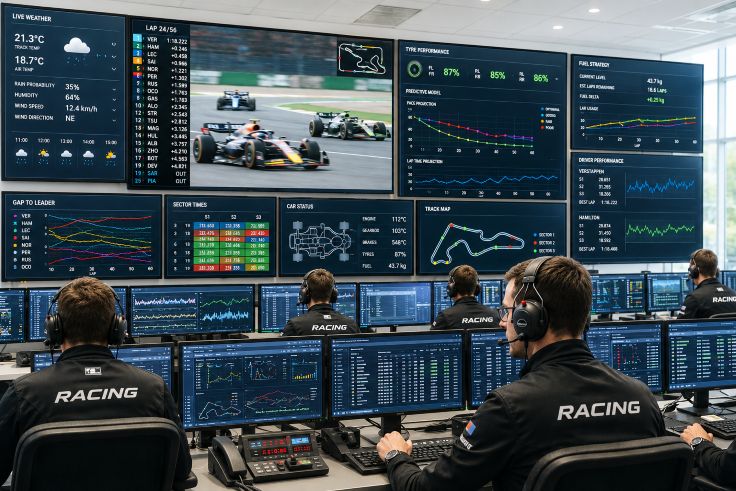
The Fédération Internationale de l’Automobile (FIA) has reported that modern racing environments generate large volumes of telemetry data during events, with information collected from vehicle systems, tire behavior, fuel use, and driver performance metrics. Racing is no longer shaped only by speed on the track. Behind every lap exists a growing network of information that helps teams understand patterns, improve decisions, and evaluate changing conditions in real time.
As digital systems continue to evolve, researchers and observers often use multiple information sources to study how data environments function. Platforms that provide online account access like the Didihub login are sometimes referenced as examples of connected digital ecosystems because they organize user interactions and behavioral patterns through structured systems. Similar concepts appear in racing analytics, where large amounts of information are collected and interpreted to support analysis rather than relying solely on instinct.
Racing Data and the Shift Beyond Raw Speed
McKinsey & Company has discussed how industries increasingly depend on data-driven decision models because large datasets can reveal patterns that human observation alone may overlook. Racing environments provide a useful example of this trend.
Historically, race outcomes were commonly associated with driver skill and mechanical reliability. While those factors remain important, modern racing increasingly combines human judgment with analytical systems.
Teams monitor information that includes:
- Vehicle speed across track sections
- Tire temperature fluctuations
- Fuel consumption rates
- Brake performance
- Weather conditions
- Driver reaction timing
- Track surface changes
These measurements create a broader understanding of how multiple variables interact. Racing therefore becomes an environment where information itself gains strategic value.
This perspective creates an interesting discussion. One viewpoint argues that analytics improve understanding because decisions become more informed. Another viewpoint suggests that excessive dependence on data may reduce flexibility if teams become overly reliant on numerical models.
Reality often exists between these perspectives. Data can improve visibility, yet human interpretation still plays a major role.
Predictive Systems and the Search for Patterns
Prediction systems attempt to estimate possible outcomes by identifying relationships between historical and real-time information. Rather than producing certainty, these systems estimate probabilities based on available conditions.
The Massachusetts Institute of Technology (MIT) has explained that predictive analytics works by combining historical observations with computational models designed to identify recurring patterns.
Racing systems may evaluate questions such as:
- How tire wear may change over several laps
- Whether weather conditions could affect vehicle handling
- How pit stop timing may influence overall performance
- How traffic conditions on the track may alter race flow
Predictive systems continue to attract both support and criticism. Supporters argue that advanced modeling improves preparation because teams can anticipate multiple scenarios.
Critics point out that prediction models remain limited because unpredictable events continue to exist. Mechanical failures, human reactions, and changing environments can introduce variables that are difficult to forecast.
Both perspectives contain practical value. Prediction systems do not eliminate uncertainty. Instead, they help organize uncertainty into measurable possibilities.
Decision-Making Under Pressure
Fast environments create situations where decisions often need to happen within seconds. Racing illustrates how people process information when time becomes limited.
Harvard Business Review has examined how decision quality often depends on balancing analytical information with practical judgment. Large quantities of information alone do not automatically improve choices.
Consider a race situation where changing weather conditions begin affecting tire performance. Analytical systems may recommend one action while human observation suggests another possibility.
Decision-making often becomes a process involving:
- Reviewing available information
- Evaluating potential outcomes
- Considering uncertainty
- Making time-sensitive choices
Digital environments outside racing increasingly follow similar patterns. Businesses, transportation systems, and financial platforms frequently depend on organized user dashboards and account management systems that provide structured account entry functions and behavioral tracking information.
The common element is not speed itself. The common element is informed decision-making under changing conditions.
Applications Beyond Competitive Racing
The influence of racing analytics extends far beyond motorsports. Many industries now use predictive models and telemetry-style information systems in daily operations.
IBM Research has noted that predictive technologies increasingly support industries such as healthcare, logistics, manufacturing, and urban transportation.
Examples include:
- Traffic systems predicting congestion patterns
- Hospitals monitoring patient conditions
- Airlines evaluating maintenance requirements
- Supply chains forecasting demand changes
- Weather services estimating environmental risks
These applications share a similar principle. Data helps create better visibility into complex systems. Similar ideas can also be seen in discussions surrounding racing precision and tactical sports analysis, where observers examine how structured information and analytical thinking influence understanding across competitive environments.
The dialectical discussion becomes relevant again here. Some people view predictive systems as tools that increase efficiency and organization. Others raise concerns regarding privacy, algorithmic limitations, and overdependence on automated recommendations.
Neither position completely outweighs the other. Technology can improve understanding while still requiring oversight and responsible use.
The Human Element Still Matters
Despite increasing sophistication in predictive models, racing demonstrates an important reality. Information systems support decisions, but they do not replace human judgment.
Drivers continue making split-second reactions. Engineers still interpret unexpected situations. Teams continue adapting when events develop differently from forecasts.
Technology expands visibility, yet people remain responsible for understanding context.
This broader lesson extends into many digital environments. Structured platforms, predictive tools, and organized user systems can simplify processes, but interpretation still matters. Systems designed around secure user login environments and connected data interactions ultimately rely on human decisions for meaningful outcomes.
Responsible Considerations
In betting-related environments, predictive information and analytics should be understood as informational tools rather than certainty mechanisms. Data patterns can provide context, but uncertainty remains present in all competitive activities. Responsible participation and balanced expectations remain important considerations.
Conclusion
Racing analytics represents more than measurements of speed and competition. It demonstrates how data collection, predictive systems, and decision frameworks increasingly shape modern environments. The discussion surrounding these technologies continues because both opportunities and limitations exist.
As connected systems continue evolving, the larger takeaway becomes clear. Information can improve understanding, yet outcomes still depend on interpretation, judgment, and responsible use. Whether examining motorsports, transportation systems, or secure user access environments, data serves as a tool for insight rather than a replacement for human thinking.